.jpeg)

Japan International Cooperation Agency (JICA) - AQAL Project

1. Background and Need for ALPs in Pakistan
- Educational Challenges: Pakistan faces significant educational gaps, with 78% of public schools being primary-level, leading to a high number of out-of-school children (OOSC), especially in the 10-16 age group.
- Purpose of ALPs: ALPs provide a fast-track, flexible, and cost-effective solution to bridge the education gap for overage children, particularly those who have missed out on schooling due to poverty, labor, or lack of access to schools.
- Target Groups: ALPs focus on children who have completed primary education but cannot continue due to the unavailability of middle schools, with a special emphasis on girls and marginalized communities.
2. What is Accelerated Learning?
- ALPs are a form of Non-Formal Basic Education (NFBE) designed for OOSC, offering equivalent learning outcomes to formal education in a shorter timeframe.
- The programs are flexible, age-appropriate, and cater to children who have had their education interrupted due to various socioeconomic factors.
- ALP Primary covers primary education in 30 months, while ALP Middle-Tech offers middle-level education and vocational skills in 18 months.
.jpg)
.png)
3. ALP Landscape in Pakistan
- Implementation Status: ALPs are being implemented by 92 providers, including government bodies, provincial departments, and development partners.
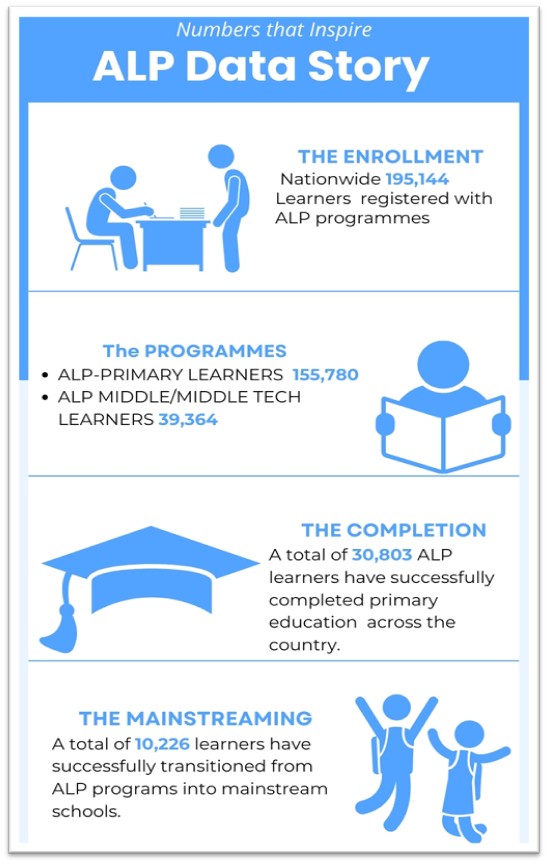
- Enrollment: As of the report, 155,780 children are enrolled in ALP Primary, and 39,364 in ALP Middle-Tech, totaling 195,144 learners.
- Delivery Models: ALPs are delivered through various models, including community-based schools, mobile schools, and evening shifts, ensuring accessibility in remote and urban areas.
.png)
4. Viability of ALPs
- Alignment with National and International Goals: ALPs support Pakistan’s national education policies and contribute to Sustainable Development Goal 4 (SDG 4) by increasing access to quality education.
- Cost-Effectiveness: ALPs are half the cost of formal education, making them a scalable solution in resource-constrained settings.
- Adaptability: The curriculum is designed to be context-specific and responsive to student needs, ensuring effectiveness across diverse settings.
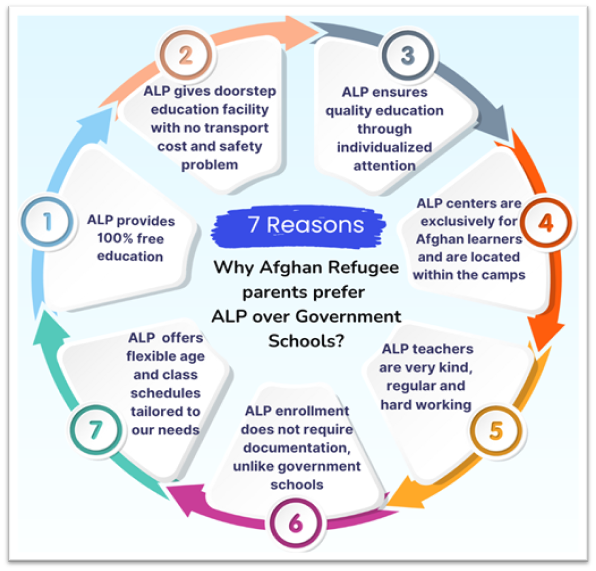
- Reaching Vulnerable Groups: ALPs prioritize girls, children from marginalized communities, and refugees, with 84% of centers located in rural and remote areas.
- Community Engagement: Strong community involvement is a cornerstone of ALPs, with local residents actively participating in center operations.
- Pathway to Mainstreaming: ALPs provide valid certification, enabling learners to transition to formal education or vocational training.
5. Effectiveness of ALPs
- Survival and Completion Rates: ALPs show higher survival and completion rates compared to conventional education programs, with 70% of learners reaching the terminal grade (Package C).
- Transition to Formal Education: Over 90% of ALP graduates successfully transition to formal education, with many enrolling in Grade 6.
- Improved Learning Outcomes: ALP learners demonstrate significant improvements in subject proficiency, life skills, and social skills.
- Community Attitudes: ALPs have positively influenced community attitudes toward education, with parents and communities advocating for the expansion of ALP programs.
6. Research and Evidence
- Agha Khan University Study: Research shows that ALP curriculum and teaching strategies lead to better learning outcomes compared to conventional methods.
- NEAS Comparative Study: ALP learners outperformed formal school students in English, Urdu, and Mathematics, with an average score of 62.3% compared to 55.7% in formal schools.
7. Monitoring and Quality Improvement
- Robust Monitoring Framework: ALPs are monitored through the National Non-Formal Education Management Information System (NFEMIS), enabling data-driven decision-making and continuous improvement.
- Teacher Training: Over 2,482 teachers have been trained through the AQAL project, leading to improved teaching effectiveness.
- Innovative Teaching Methods: ALPs use activity-based teaching and learner-centered approaches to enhance educational outcomes.
8. Conclusion
- ALPs are a viable and effective solution to address Pakistan’s educational challenges, particularly for out-of-school children and marginalized communities.
- The programs are cost-effective, scalable, and have shown positive results in terms of learning outcomes, transition rates, and community engagement.
- Continued investment in ALPs, along with teacher training and monitoring, is essential to ensure their long-term success and impact.